
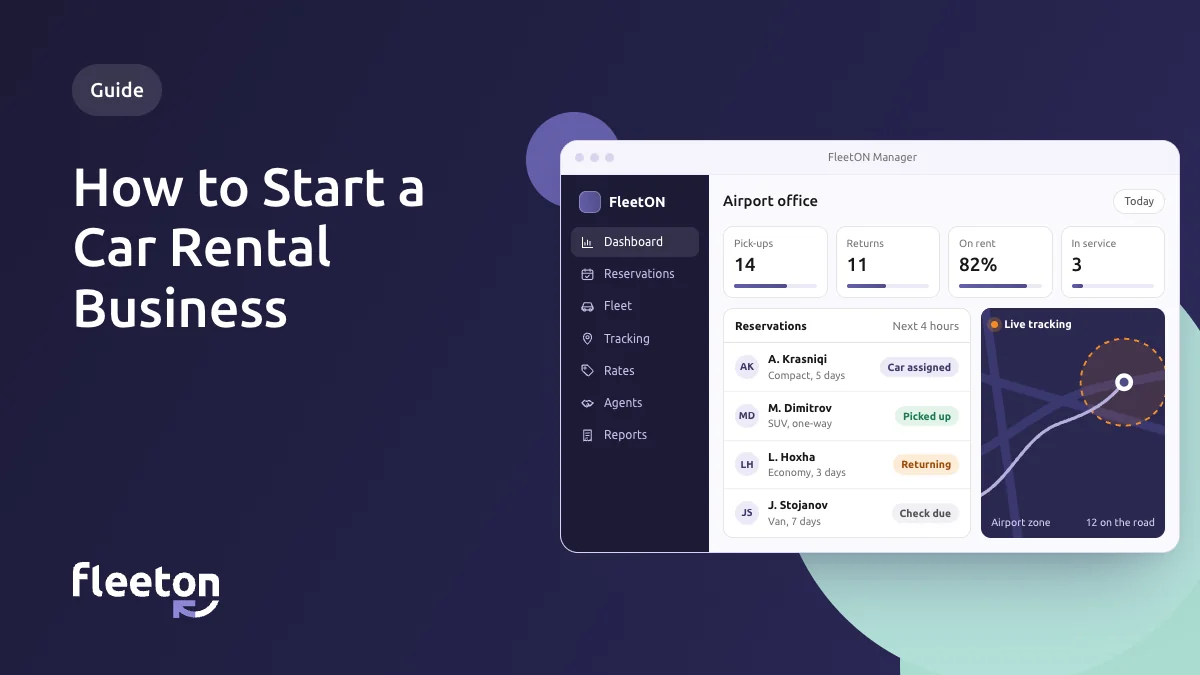
Starting a car rental business is mostly a question of three things: finding demand you can serve better than the companies already there, financing a fleet without running out of cash in the quiet months, and running the daily work (bookings, handovers, deposits, damage, maintenance) without errors. This guide walks through the steps in order, from the first market check to your first season.
1. Check the demand in your market
Car rental demand is local. Before you buy a single car, find out who rents cars where you want to operate and why:
- Tourists arriving at an airport, port or train station, often booking through brokers months ahead.
- Business travellers and companies that need cars for staff, often with monthly invoicing.
- Locals whose own car is in the workshop, or who need a van for a weekend.
- Replacement rentals for insurers and garages.
Look at who already serves these customers, their prices in high and low season, and the reviews they get. Search the big rental brokers for your city and dates: you will see how many suppliers there are, which car groups sell out and what customers pay. Gaps in service, such as late-night airport pick-ups, delivery to hotels or a language your competitors do not speak, are often a better start than lower prices.
2. Choose your niche and business model
Most successful new rental companies start narrow and grow:
- Airport and tourist rentals: high volume, strong seasons, heavy use of brokers.
- Local and corporate rentals: steadier demand, longer rentals, more direct customers.
- Vans and special vehicles: fewer competitors, higher daily rates, more specialised customers.
- Premium cars: higher margins, higher deposits and insurance costs, more risk per car.
- Monthly rentals and subscriptions: lower daily price, but fewer handovers and steadier income.
3. Write a business plan with real numbers
Your plan should answer one question: how many days per month must each car be rented, at what price, to cover its costs? Work it out per car:
- Monthly cost per car: loan or lease payment, insurance, maintenance, tyres, cleaning, parking and a share of your office and staff costs.
- Expected price per day in high, middle and low season, after broker commission where it applies.
- Expected utilization: the share of days each car is rented. Be conservative for the first year.
From these you get the break-even number of rented days per car. Add the seasonal pattern month by month, and you can see when cash will be tight and how much reserve you need. Revisit the plan after the first season with your real numbers.
4. Handle the legal side
Rules differ a lot between countries and even cities, so check with a local accountant or lawyer before you start. Typically you will need:
- A registered company and a business licence for vehicle rental, where your country requires one.
- Vehicle registration that allows rental use; in some countries rental cars need special plates or permits.
- Rental insurance for your fleet, which differs from private car insurance.
- A rental agreement and terms and conditions that follow consumer law, plus a privacy policy for the personal data you keep.
- Invoicing that meets local rules, including electronic invoicing or fiscalization where required. In some countries, such as Saudi Arabia, rental contracts themselves must be registered electronically.
5. Finance and build the fleet
The fleet is your biggest cost and your biggest risk. Common options are buying with a loan, leasing, or buy-back agreements where a dealer takes the cars back after a set time. Leasing and buy-back reduce the cash you need and the resale risk, while buying gives more freedom and can be cheaper over the life of the car.
Start with the car groups your market check showed are in demand, and keep the number of models small: fewer models mean simpler maintenance, simpler pricing and easier swaps when a car is not ready. Plan for growth in the high season with short-term leases instead of buying cars that will stand idle in winter.
6. Set up insurance, deposits and damage handling
Decide what the customer pays if something happens: the excess (deductible), the deposit you hold on their card, and the extra cover you sell to reduce it. Write it clearly in your terms, show it before the customer pays, and record the car’s condition with photos at every pick-up and return. Clear rules and photos prevent most disputes, and damage you can prove is damage you can charge.
7. Choose your location and opening hours
Airport desks are expensive but bring the most walk-in and broker business. Many new companies start with a nearby office and a meet-and-greet service at the airport, delivering and collecting cars at the terminal. Whatever you choose, flight times decide your opening hours in tourist markets: late arrivals are a common reason customers choose one supplier over another.
8. Set your prices
Build rates per car group with prices that change by season, rental length and how far ahead the customer books. Add one-way fees, young-driver fees, extras such as child seats and additional drivers, and your deposit rules. Then compare your final price, as the customer sees it, with competitors on the brokers and on their own websites. Rates that react to demand, rising when a car group is nearly sold out, will earn more than a fixed price list.
9. Get bookings from several channels
- Your own website: no commission, and the customer is yours for the next rental. You need a booking engine with live availability and online payment, such as the FleetON Booking Portal. See car rental website.
- Brokers: the fastest way to reach international customers, in exchange for commission. Connecting them directly to your system avoids double bookings. See broker integration.
- Hotels, travel agents and partners: they can book for their guests at agreed rates through an Agent Portal.
- Corporate customers: steady bookings and longer rentals, usually invoiced monthly.
- Google Business Profile and reviews: free, and often the first thing a local customer sees.
10. Choose your car rental software early
A spreadsheet works for five cars. With more cars, more channels and more staff, it becomes the source of double bookings, lost deposits and forgotten services. Car rental software keeps bookings from every channel in one fleet, prepares contracts, takes payments and deposits, records damage and reminds you of maintenance. Choosing it before you open means your processes are built around it from day one.
FleetON is built to grow with a rental company, from a first office to many countries. It starts from €99 a month, setup typically takes 1 to 2 weeks, and the monthly fees come with a 90-day money-back guarantee. See FleetON for new rental companies, and our guide to car rental software.
11. Run the first season and measure
Track a few numbers from the first week: fleet utilization by car group, revenue per available car day, bookings by channel, average handover time, and damage and maintenance costs per car. Our guide to rental fleet management explains how to calculate and improve them. After the first season, use them to decide which cars to keep, which to add and which channels to grow.
Frequently asked questions
How much does it cost to start a car rental business?
It depends mostly on the size of the fleet and how you finance it. The main start-up costs are the cars (or the deposits on leases), insurance, an office or desk, your website and software, and enough cash to cover the quiet months. Build the number per car in your business plan, then multiply by the fleet you start with.
Is a car rental business profitable?
It can be, when cars are rented enough days at the right price and costs per car are under control. Profit depends on utilization, pricing, how much commission you pay to brokers and how well you handle damage and maintenance.
How many cars do I need to start?
Many companies start with a small fleet that matches the demand they are sure of, and add short-term leased cars in the high season. Starting small keeps the risk low while you learn your market.
Do I need software from the start?
It is easier to start with software than to switch later. Bookings, contracts, deposits and damage records then live in one place from the first rental.
Planning a new rental company? Book a 30-minute meeting and we will show you how FleetON would run it.